Home Backup Generator Calculator
Calculate the perfect generator size for your home by selecting your appliances, estimating running and starting loads, fuel consumption, runtime, generator price, and backup recommendations.
Select appliances to see your load
Fuel Consumption & Cost
Consumption by load
Fuel cost estimate
Home Backup Generator Cost Estimate
Approximate purchase price for a 0 kVA diesel generator in your selected country.
Home Standby Generator Sizing Chart
Compare common generator sizes side by side. Your recommended size is highlighted.
| Size | Typical Home | Max Running Load | Starting Capacity | Fuel Usage (75%) | Suitable For |
|---|
How to Use This Home Backup Generator Calculator
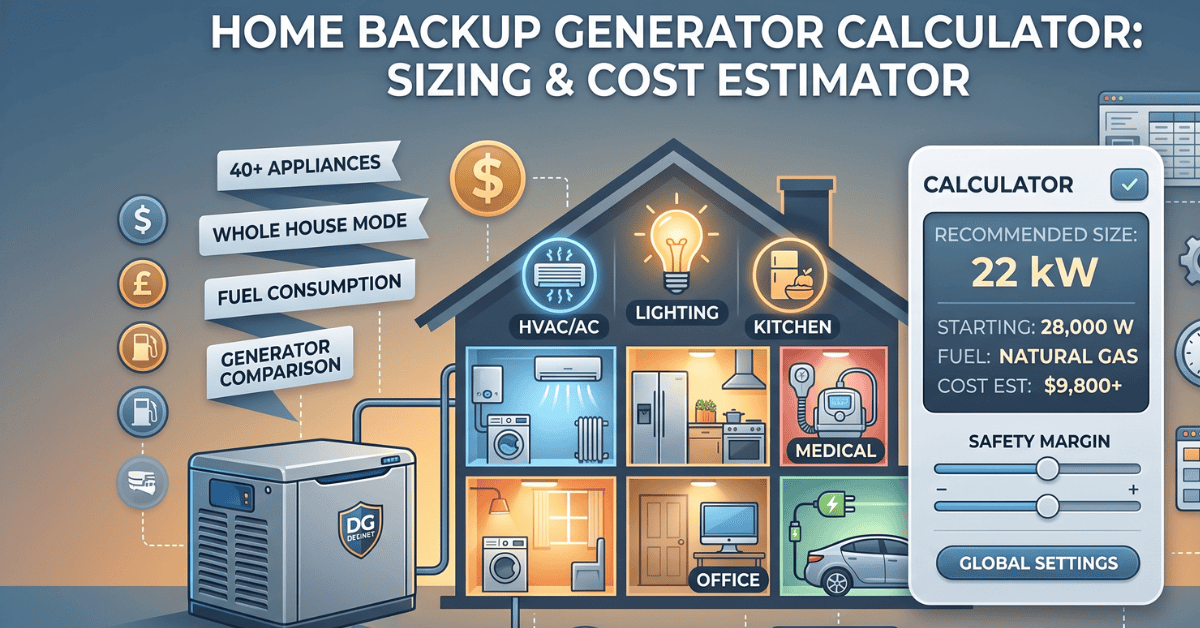
This home backup generator calculator helps you size a whole house backup generator or an essential loads system in a few steps. Start by choosing your country so the tool can apply the right voltage, frequency, and local fuel and equipment pricing. Then pick your power system, generator type, and a home template that roughly matches your property.
From there, use the appliance database to fine tune exactly what you want to run during an outage. Each appliance shows its running watts and starting watts, and you can adjust the quantity for anything you own more than one of. The results panel on the right updates instantly as you check boxes, change quantities, or move the safety margin slider, so you can see how each decision changes the recommended home backup generator size.
How Generator Size is Calculated
A home backup generator sizing calculator needs to account for both the steady electrical demand of your appliances and the short surge that motor-driven appliances draw when they switch on. The tool adds up the running watts of everything you selected, then separately works out the highest starting surge by taking the single largest starting load and combining it with the running watts of everything else.
Once the larger of these two figures is known, a safety margin is applied and the result is matched against standard generator sizes to find the smallest unit that comfortably covers your home. The single phase formula used is current equals watts divided by voltage times power factor, while the three phase formula divides by the square root of three multiplied by voltage and power factor, giving you a realistic rated current for your chosen system.
Running Watts vs Starting Watts
Running watts describe the continuous power an appliance needs once it is already operating, while starting watts describe the brief surge many motor-driven devices need the instant they switch on. Air conditioners, refrigerators, well pumps, and power tools can momentarily draw two to three times their running wattage for a fraction of a second, and if a generator cannot supply that surge it can stall or trip.
Because only one large motor typically starts at a time in a home, generators only need enough starting capacity for the single biggest surge on top of everything else that is already running, which is exactly how this calculator’s required generator watts figure is derived.
How Much Generator Capacity Do You Need?
The right amount of generator capacity depends heavily on whether you want to power only essential circuits or your entire home. An essential loads setup, often in the 5 to 10 kVA range, typically covers refrigeration, lighting, a well pump, and a few outlets. A whole house backup generator, often 15 kVA and above for larger homes, is sized to handle central air conditioning, electric ranges, dryers, and everything else running at once.
Use the home backup generator wattage calculator above with your actual appliance list rather than rough size guides, since two homes of the same square footage can have very different loads depending on whether they use gas or electric heating, well water, or central air conditioning.
Diesel vs Petrol vs Natural Gas Generators
Diesel
Efficient at sustained loads, long service life, and widely used for whole house backup generator installations, though it needs on-site fuel storage.
Petrol
Lower upfront cost and common in portable units, but less fuel efficient and generally unsuitable for continuous multi-day backup power.
Natural Gas
Connects to an existing gas line for effectively unlimited runtime, a popular choice for automatic home standby generator sizing where uninterrupted power matters most.
LPG
Stores well for long periods without degrading, making it a solid backup fuel choice in regions without piped natural gas.
What Safety Margin Should You Use?
A safety margin adds headroom above your calculated load so the generator is not run at its absolute limit, which extends its service life and leaves room for future appliances. Ten to twenty percent is a common margin for a well defined essential loads setup, while homes planning to add appliances later, or properties in hot climates leaning on air conditioning, often choose twenty five to thirty five percent.