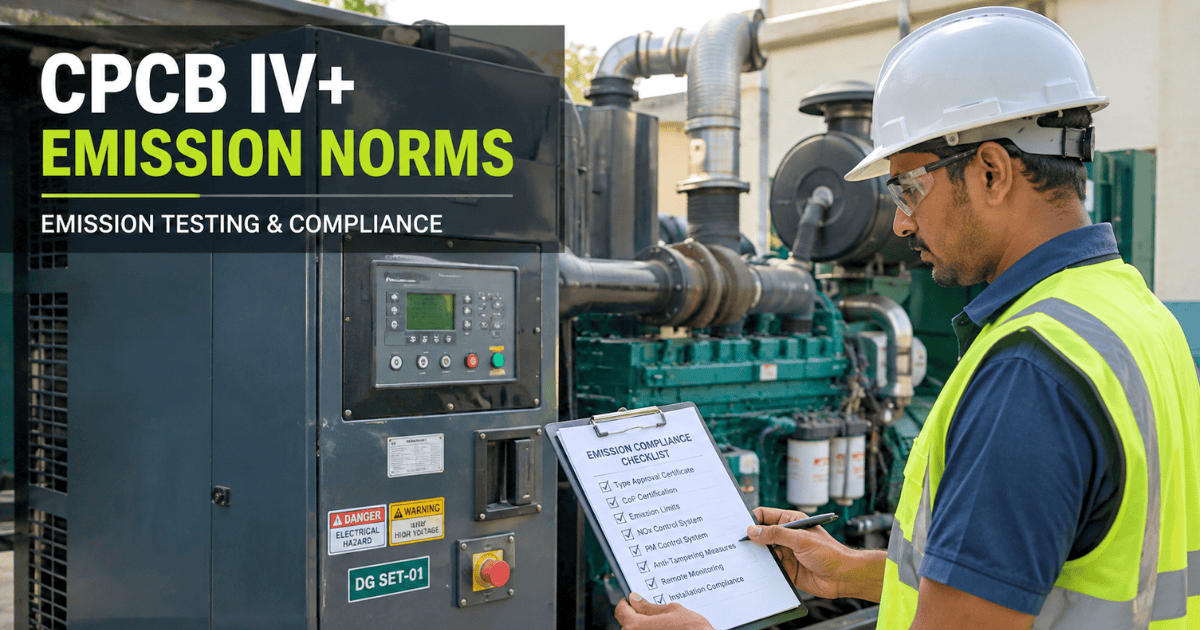
What Are CPCB IV+ Emission Norms?
CPCB IV+ emission norms are the revised emission requirements applicable to specified internal combustion engines used for power-generating sets (DG sets) in India.
The revised emission standards were notified by the Ministry of Environment, Forest and Climate Change (MoEF&CC) through GSR 804(E.) dated 3 November 2022. The Central Pollution Control Board (CPCB) subsequently prepared the detailed System and Procedure for Compliance to Revised Emission Standards to explain how manufacturers and certification agencies should test, certify and demonstrate compliance.
The official CPCB document covers genset engines with gross mechanical power up to 800 kW and provides requirements for emission limits, testing, Type Approval, Conformity of Production (CoP), NOx and particulate control, anti-tampering measures, remote monitoring, installation and safety requirements.
The CPCB document itself states that these revised emission norms can also be referred to as “CPCB IV+ emission regulation.”
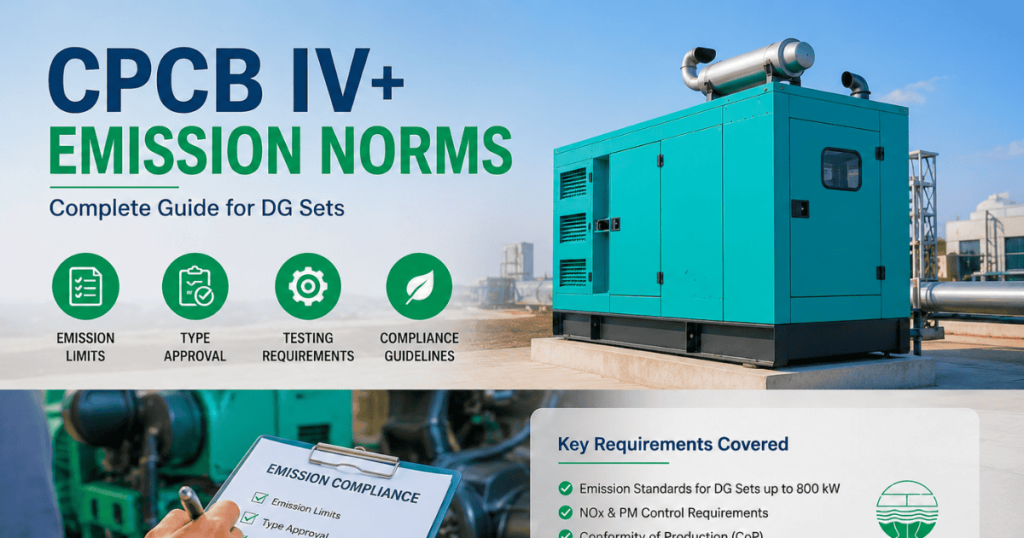
CPCB IV+ Emission Norms PDF Download
If you are looking for the CPCB IV+ emission norms PDF download, the complete official CPCB System and Procedure document used as the basis for this article is available here.
Official document: System and Procedure for Compliance to Revised Emission Standards (dated 03.11.2022) for Power Generating Set Engines (Up-to Gross Mechanical Power 800 KWs)
Document date: 28 March 2023
Issued by: Central Pollution Control Board (CPCB), Ministry of Environment, Forest and Climate Change
Scope: Power generating set engines up to 800 kW gross mechanical power
Notification: GSR 804(E.), dated 3 November 2022
*Official Reference: Central Pollution Control Board (CPCB), System and Procedure for Compliance to Revised Emission Standards (dated 03.11.2022) for Power Generating Set Engines (Up-to Gross Mechanical Power 800 KWs), dated 28 March 2023. The revised emission standards were notified by MoEF&CC through G.S.R. 804(E), dated 03 November 2022.
Official CPCB Guidelines: CPCB Guidelines – Central Pollution Control Board
This 417-page document contains the detailed procedures, emission limits, testing requirements, certification procedures, technical requirements and safety provisions covered by CPCB IV+.
Key Points of CPCB IV+ Norms for DG Sets
In simple terms, the CPCB IV+ framework introduces or strengthens requirements related to:
- Exhaust emissions
- NOx emissions
- Hydrocarbon (HC) emissions
- Carbon monoxide (CO)
- Particulate matter (PM)
- Smoke
- Type Approval
- Conformity of Production (CoP)
- Emission durability and deterioration factors
- NOx Control Diagnostics (NCD)
- Particulate Control Diagnostics (PCD)
- Emission-control systems
- Anti-tampering provisions
- Remote information and monitoring
- Genset installation
- Fuel specifications
- Dual-fuel engines
- Alternate-fuel engines
- Product labelling
- Safety requirements for gaseous-fuel systems
The document is therefore much more than a table of emission limits. It establishes a complete compliance framework for manufacturers, importers, assemblers, certification agencies and other stakeholders.
Applicability of CPCB IV+ Emission Norms
The overall scope covers new internal combustion engines up to 800 kW gross mechanical power used for generator-set applications.
The document covers several categories of engines and fuels.
1. Compression Ignition (CI) Engines
Part A1 applies to compression-ignition engines, including:
- Diesel engines
- Dual-fuel engines operating on diesel and specified alternate fuels
For the CI category, the document considers emissions of:
- CO
- HC
- NOx
- Particulate matter
- Smoke
It covers both constant-speed and variable-speed operation.
2. Positive Ignition (PI) Engines
Part A2 covers positive-ignition engines above the specified displacement threshold and includes engines using dedicated alternate fuels and bi-fuel configurations.
The document considers fuels such as natural gas/biomethane, LPG and various specified alternate fuels, subject to applicable fuel specifications.
3. Portable Generator Sets
Part A3 deals with portable generator sets.
The document defines portable electric generators in this section as units up to 19 kW and up to 800 cc engine displacement, powered by PI air-cooled engines and mounted on hand-cart type units.
4. Safety Code of Practice
Part A4 provides safety requirements for engines other than gasoline and diesel, particularly systems using gaseous fuels such as:
- CNG
- PNG
- LPG
It covers fuel cylinders, fittings, fuel lines, ventilation, installation, inspection, leak testing, commissioning, labelling and related safety requirements.
CPCB IV+ Emission Limits for Diesel DG Sets
For most people searching for CPCB IV+ emission norms for DG sets, the emission-limit table is one of the most important parts of the regulation.
For compression-ignition engines, the CPCB document provides limits for CO, HC, NOx, PM and smoke.
Emission Limits for CI Genset Engines up to 800 kW
| Power Category | NOx (g/kWh) | HC (g/kWh) | NOx + HC (g/kWh) | CO (g/kWh) | PM (g/kWh) | Smoke (m⁻¹) |
|---|---|---|---|---|---|---|
| P ≤ 8 kW | — | — | 7.5 | 3.5 | 0.30 | 0.7 |
| 8 < P ≤ 19 kW | — | — | 4.7 | 3.5 | 0.30 | 0.7 |
| 19 < P ≤ 56 kW | — | — | 4.7 | 3.5 | 0.03 | 0.7 |
| 56 < P ≤ 560 kW | 0.40 | 0.19 | — | 3.5 | 0.02 | 0.7 |
| 560 < P ≤ 800 kW | 0.67 | 0.19 | — | 3.5 | 0.03 | 0.7 |
These are the values specified in Table 1 of the CI-engine section of the CPCB System and Procedure document.
Important: The applicable test result is evaluated considering the applicable deterioration factor and adjustment factor specified by the procedure. Therefore, simply comparing an unadjusted laboratory result with the table is not necessarily sufficient to establish compliance.
CPCB IV+ Emission Limits for Positive Ignition Engines
The document also establishes emission limits for PI-powered genset engines.
For PI engines, the limits vary according to power category.
| Power Category | NOx (g/kWh) | HC (g/kWh) | NOx + HC (g/kWh) | CO (g/kWh) |
|---|---|---|---|---|
| P ≤ 8 kW | — | — | 7.5 | 3.5 |
| 8 < P ≤ 19 kW | — | — | 4.7 | 3.5 |
| 19 < P ≤ 56 kW | — | — | 4.7 | 3.5 |
| 56 < P ≤ 560 kW | 0.40 | 0.19 | — | 3.5 |
| 560 < P ≤ 800 kW | 0.67 | 0.19 | — | 3.5 |
The document specifies the applicable test cycles and requires manufacturers to declare the selected test-cycle type during the Type Approval process.
What Is Type Approval Under CPCB IV+?
Type Approval (TA) is a fundamental part of CPCB IV+ compliance.
In simple terms, a manufacturer cannot simply manufacture a DG set and claim that it meets the emission requirements. The engine type or engine family has to demonstrate compliance through the prescribed certification and testing process.
The CPCB procedure states that no person or agency shall sell, import or use a genset engine in India without the required valid Type Approval Certificate and Conformity of Production Certificate as specified in the procedure.
Type Approval involves:
- Identification of the engine type or engine family
- Submission of technical information
- Selection of an approved certification agency
- Testing according to the prescribed procedure
- Verification of emission performance
- Evaluation of applicable requirements
- Issue of the Type Approval Certificate when compliance is demonstrated
The document lists approved technical agencies including ARAI, ICAT and IIP, subject to the provisions and updates applicable under the CPCB framework.
What Is Conformity of Production (CoP)?
Type Approval alone is not the end of the compliance process.
Conformity of Production (CoP) is intended to ensure that engines manufactured after Type Approval continue to conform to the approved emission requirements.
The CPCB procedure requires manufacturers to subject their applicable engine model ranges to CoP verification periodically.
The CoP year runs from 1 July of one calendar year to 30 June of the following year.
For domestically manufactured engines above 19 kW and imported engines of all ratings, the document specifies CoP verification once for every 1,000 units per family or once a year, whichever is earlier.
The procedure also introduces annual compliance demonstrations for applicable NOx Control Diagnostics (NCD) and Particulate Control Diagnostics (PCD) families.
CPCB IV+ Testing Requirements
Emission compliance is determined through prescribed test procedures rather than simply measuring smoke from a DG set in normal operation.
The CPCB document specifies test equipment, test-bed measurement systems, test cycles, fuel specifications, data evaluation and calculation methods.
For CI engines, the document refers to standards including:
- ISO 8178-1
- ISO 8178-3
- ISO 8178-4
- ISO 8178-7
- ISO 8178-9
- Relevant AIS standards
- Applicable US EPA references
These standards are used for areas such as emission measurement, smoke measurement, test cycles and engine-family determination.
For detailed information on exhaust stack requirements, calculations, and CPCB compliance for diesel generators, see our guide on CPCB norms for DG set exhaust height .
Test cycles
For CI engines, the procedure specifies different cycles depending on the engine’s operating mode.
For constant-speed engines, the procedure specifies the D2 five-mode test cycle.
For variable-speed engines, the procedure specifies the C1 eight-mode cycle, the corresponding ramped mode option, or the specified five-mode variable-speed cycle under the applicable provisions.
Smoke Limit Under CPCB IV+
Smoke is also specifically controlled.
The procedure specifies a smoke limit of 0.7 m⁻¹ for applicable CI engines and requires the value not to exceed the limit throughout the applicable operating load points of the test cycle.
Smoke measurement is linked to the procedures specified in ISO 8178-3 and ISO 8178-9.
NOx and Particulate Control Under CPCB IV+
One of the important features of the CPCB IV+ framework is that compliance is not limited to measuring final exhaust emissions.
The procedure includes specific requirements for NOx control measures and particulate control measures.
Where an engine relies on an external device or reagent, such as urea used with an SCR system, the correct operation of the NOx-control system has to be demonstrated.
Similarly, engines using exhaust after-treatment devices to control particulate matter must meet the applicable particulate-control requirements.
What Is NOx Control Diagnostics (NCD)?
NOx Control Diagnostics, or NCD, is a system designed to identify malfunctions affecting the NOx-control system.
The CPCB procedure defines an NCD system as having the capability to:
- Detect a NOx control malfunction
- Identify the likely cause of the malfunction
- Store or communicate relevant diagnostic information
The system is intended to help ensure that emission-control systems continue to operate correctly after certification.
What Is Particulate Control Diagnostics (PCD)?
Particulate Control Diagnostics (PCD) is similarly intended to detect and identify malfunctions associated with particulate-control systems.
The requirements are particularly relevant to engines using particulate after-treatment systems.
This is an important difference between a basic emission test and the broader CPCB IV+ compliance framework: the regulation also addresses the continued functioning of emission-control technology.
CPCB IV+ Anti-Tampering Requirements
The CPCB IV+ procedure contains specific requirements intended to prevent tampering with emission-control systems.
For electronically controlled engines, manufacturers have to provide information about measures used to prevent unauthorised modification of the ECU and emission-control calibration.
For mechanically controlled emission systems, adjustable parameters must also be protected against easy tampering.
The document states that manufacturers must demonstrate to the test agency that relevant adjustable emission-control parameters cannot easily be tampered with using ordinary tools.
The operator’s manual must also contain a warning that tampering with the engine can invalidate its Type Approval.
Remote Monitoring Requirement for Certain DG Sets
Another important CPCB IV+ requirement concerns remote information and monitoring.
The procedure states that gensets powered by electronically controlled engines above 56 kW are required to have a remote information and monitoring system using telematics.
The manufacturer, together with the GOEM, is required to provide a cellular-data-based monitoring system capable of working with an application on computers and mobile devices.
The system is intended to provide information and warnings relating to emission-control malfunctions.
This requirement is particularly significant because DG sets often operate without a dedicated operator continuously present at the machine.
CPCB IV+ Emission Durability Requirements
Emission performance is also considered over the expected durability period of the engine.
The document specifies:
| Engine Power Category | Emission Durability Period |
| >19 to ≤56 kW constant-speed engines | 3,000 hours |
| >19 to ≤56 kW variable-speed engines | 5,000 hours |
| >56 kW engines | 8,000 hours |
The applicable deterioration factors are then considered when evaluating emission performance.
For engines above 19 kW, the document also provides assigned multiplicative deterioration factors for parameters including CO, HC, NOx and PM.
CPCB IV+ Requirements for DG Set Installation
CPCB IV+ compliance is not limited to the engine in isolation.
For a genset using an approved engine, the manufacturer must also ensure compliance with the applicable genset installation requirements.
The document includes a dedicated Annexure 9 dealing with installation in genset applications.
This is important because emission performance can depend on the complete genset configuration, including relevant emission-control and installation arrangements.
For information on exhaust stack requirements and height calculations for diesel generator sets, see our detailed guide on CPCB norms for DG set stack height .
CPCB IV+ Requirements for Dual-Fuel DG Sets
The CPCB procedure also contains specific provisions for dual-fuel engines.
A dual-fuel engine is generally based on diesel as the primary combustion fuel with a gaseous fuel such as:
- CNG
- Bio-CNG
- LPG
The document contains separate requirements for:
- Dual-fuel indicators
- Warning systems
- Operability restrictions
- Emission testing
- Dual-fuel classifications
- Safety checks
- Gaseous-fuel installation
- Labelling
These requirements are covered in Annexure 10 of the CI section.
CPCB IV+ Alternate Fuel DG Set Requirements
The document does not deal only with conventional diesel engines.
Its overall scope includes specified alternate fuels such as:
- Natural gas
- Biomethane
- LPG
- Ethanol blends
- Methanol blends
- Hydrogen
- Hydrogen blended with CNG
- Biodiesel
- Other fuels specified under the applicable rules
Natural gas may be used in forms such as CNG, LNG or PNG, subject to the applicable requirements.
The exact requirements depend on the engine category and fuel configuration.
CPCB IV+ Safety Requirements for CNG, PNG and LPG DG Sets
For gaseous-fuel DG sets, the document provides a separate safety code.
It covers areas such as:
- Cylinder installation
- Cylinder protection
- Ventilation
- Fuel lines
- CNG/PNG/LPG control equipment
- Fuel-system components
- Compliance plates
- Labels
- Inspection
- Leak testing
- Commissioning
- Periodic inspection
- Maintenance
- Repair
- Cylinder scrapping
- Statutory approvals
For example, the safety provisions require applicable gas-system components to meet the specified standards and require appropriate protection and installation arrangements.
CPCB IV+ DG Set Labelling Requirements
The CPCB procedure also specifies conformance-labelling requirements.
The conformance label must be durable and legible and must contain important information such as:
- Manufacturer’s name and address
- Statement of conformity with the Environment (Protection) Rules
- Type Approval certificate number
- Date of manufacture or import
- Rated speed
- Corresponding gross power
For the product, the specified noise limit information is also required on the conformance label.
This makes the label an important source of information when checking the certification details of a DG set.
Who Needs to Follow CPCB IV+ Requirements?
The compliance framework is particularly relevant to:
- DG set manufacturers
- Engine manufacturers
- Genset Original Equipment Manufacturers (GOEMs)
- Importers
- Assemblers
- DG set suppliers
- Certification agencies
- Testing laboratories
- Manufacturers of alternate-fuel systems
- Organisations purchasing new DG sets
- Technical consultants
- Environmental compliance professionals
The exact obligations depend on whether the organisation is manufacturing, importing, assembling, certifying, installing or operating the relevant equipment.
CPCB IV+ vs Older CPCB Emission Norms
People often search for:
“CPCB IV emission norms for DG sets”
and
“CPCB IV+ emission norms for DG sets.”
These terms should not automatically be treated as identical.
The official CPCB document specifically describes the revised norms arising from GSR 804(E.) dated 3 November 2022 as being referable to CPCB IV+ emission regulation.
Therefore, when researching or purchasing a new DG set, it is important to verify the exact applicable regulatory requirement rather than relying only on informal terminology such as “CPCB IV” or “CPCB IV+.”
How to Check Whether a DG Set Is CPCB IV+ Compliant
For a purchaser, the following checklist can be useful.
Before purchasing a new DG set:
- Check the engine and genset model.
- Check the applicable power category.
- Ask the manufacturer/supplier about Type Approval.
- Ask for the relevant Type Approval Certificate.
- Check the applicable CoP certification.
- Check the emission-control system.
- Check whether NCD/PCD requirements apply.
- Check the conformance label.
- For gaseous-fuel systems, verify the applicable safety and installation requirements.
- Keep the relevant certification documents for your records.
A manufacturer or supplier should be able to provide appropriate certification information for the applicable model.
CPCB IV+ Compliance: Type Approval vs CoP
A simple way to understand the difference is:
| Type Approval | Conformity of Production |
|---|---|
| Establishes compliance of the engine type/family | Checks continued production compliance |
| Conducted during approval | Repeated during applicable CoP periods |
| Establishes the approved configuration | Verifies production remains consistent |
| Results in Type Approval Certificate | Results in CoP Certificate |
| Important for placing compliant products on the market | Important for continuing compliant production |
The CPCB procedure specifically describes CoP as a mechanism for ensuring that engines sold under an emission certification continue to meet the applicable requirements.
Important Standards Referred to in the CPCB IV+ Procedure
The CPCB document uses or refers to several technical standards and regulations.
Some of the important references include:
- ISO 8178-1 – Exhaust emission measurement and test-bed measurement systems
- ISO 8178-3 – Smoke measurement for compression-ignition engines
- ISO 8178-4 – Steady-state and transient test cycles
- ISO 8178-7 – Engine family determination
- ISO 8178-9 – Smoke measurement using opacimeter-based procedures
- AIS 024
- AIS 028
- Applicable CMVR provisions
- Relevant US EPA references
These standards form part of the technical basis used by the System and Procedure for emission testing and certification.
What Does the CPCB IV+ PDF Contain?
The official 417-page document is divided into four major sections:
Part A1 – Compression Ignition Engines
This section covers diesel and applicable dual-fuel engines.
It includes:
- Scope
- Definitions
- Emission limits
- Type Approval
- CoP
- Testing
- Fuel specifications
- Emission-control strategies
- NOx control
- Particulate control
- Anti-tampering
- Remote monitoring
- Installation
- Dual-fuel requirements
Part A2 – Positive Ignition Engines
This section covers applicable PI engines and their emission, certification and testing requirements.
Part A3 – Portable Generator Sets
This section deals specifically with portable generator sets, including emission limits, Type Approval, CoP, testing, labelling and alternate-fuel requirements.
Part A4 – Safety Code of Practice
This section deals with safety requirements for applicable gaseous-fuel systems, including CNG, PNG and LPG installations.
The document’s table of contents confirms this four-part structure.
Frequently Asked Questions About CPCB IV+ Emission Norms
What are CPCB IV+ emission norms?
CPCB IV+ emission norms are revised emission requirements for specified internal combustion engines used in power-generating sets. They were notified through GSR 804(E.) dated 3 November 2022, with CPCB subsequently publishing the System and Procedure for compliance.
What is the maximum DG set power covered by CPCB IV+?
The uploaded CPCB System and Procedure covers new genset engines up to 800 kW gross mechanical power.
Is CPCB IV+ applicable to diesel DG sets?
Yes. Part A1 of the document specifically covers compression-ignition engines, including diesel engines used for genset applications.
What emissions are controlled under CPCB IV+?
For CI engines, the procedure specifies limits for CO, HC, NOx, particulate matter and smoke, as applicable to the power category and engine type.
What is the CPCB IV+ smoke limit?
For applicable compression-ignition engines, the specified smoke limit is 0.7 m⁻¹. The smoke value must remain within the applicable limit throughout the relevant test-cycle load points.
What is Type Approval in CPCB IV+?
Type Approval is the certification process through which an engine type or engine family demonstrates compliance with the applicable emission requirements using the prescribed test procedures.
What is CPCB IV+ CoP?
CoP means Conformity of Production. It is the periodic verification process intended to ensure that production engines continue to comply with the approved emission requirements.
What is the CPCB IV+ CoP year?
The CPCB procedure defines the CoP year as the period from 1 July to 30 June of the following year.
Does CPCB IV+ include NOx control?
Yes. The procedure contains dedicated requirements for NOx control measures and NOx Control Diagnostics (NCD).
Does CPCB IV+ include particulate-control requirements?
Yes. The procedure contains requirements for particulate-control measures and Particulate Control Diagnostics (PCD), where applicable.
Does CPCB IV+ require remote monitoring?
For electronically controlled engines above 56 kW, the procedure specifies a remote information and monitoring system using telematics.
Where can I download the CPCB IV+ emission norms PDF?
The complete official document titled “System and Procedure for Compliance to Revised Emission Standards (dated 03.11.2022) for Power Generating Set Engines (Up-to Gross Mechanical Power 800 KWs)”, dated 28 March 2023, is the relevant CPCB document used for this guide.
Download the CPCB IV+ Emission Norms PDF
Final Takeaway
CPCB IV+ is not simply another emission-limit table for diesel generators. It provides a broader compliance framework covering emission performance, testing, Type Approval, Conformity of Production, durability, NOx and particulate diagnostics, anti-tampering, remote monitoring, installation, alternate fuels and safety requirements.
For diesel DG sets, the applicable emission limits vary according to engine power category, and compliance has to be demonstrated through the prescribed certification and testing procedures.
If you are a DG set manufacturer, importer, supplier, consultant or buyer, understanding the Type Approval and CoP requirements is just as important as knowing the numerical emission limits.
For detailed technical requirements, the complete CPCB System and Procedure should be referred to rather than relying only on a summary article.
Source: Central Pollution Control Board, System and Procedure for Compliance to Revised Emission Standards (dated 03.11.2022) for Power Generating Set Engines (Up-to Gross Mechanical Power 800 KWs), dated 28 March 2023.
Note: This article is an explanatory summary of the CPCB document and is intended for informational purposes only. Regulatory requirements can be amended or updated. For regulatory compliance, certification or legal decisions, readers should verify the applicable notification and current requirements through the official CPCB Guidelines and applicable MoEF&CC notifications.