
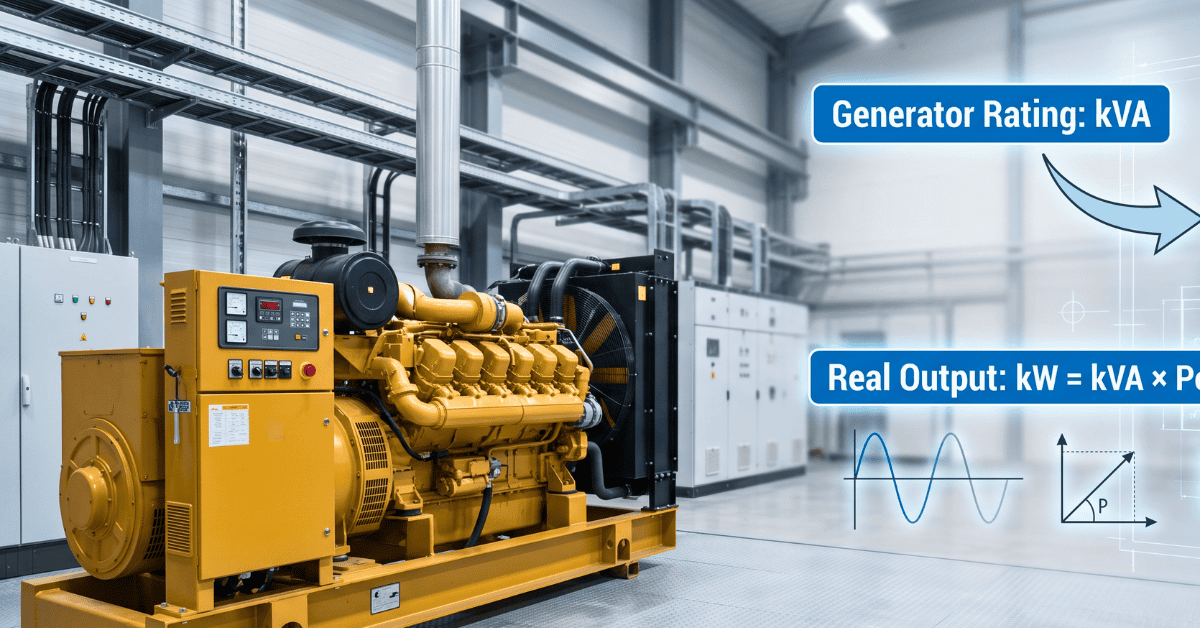
Why Diesel Generator Rating in kVA?
If you have ever looked at the specifications of a diesel generator, you may have noticed that almost every manufacturer mentions the generator capacity in kVA instead of kW. This often raises a common question:
Why diesel generator rating in kVA and not in kW?
The answer lies in the relationship between apparent power, real power, and power factor. Since the generator does not know what type of electrical load will be connected, manufacturers rate it in kVA, which represents the total electrical power the generator can supply.
Understanding this concept helps engineers, facility managers, industries, and buyers select the correct generator for their applications.
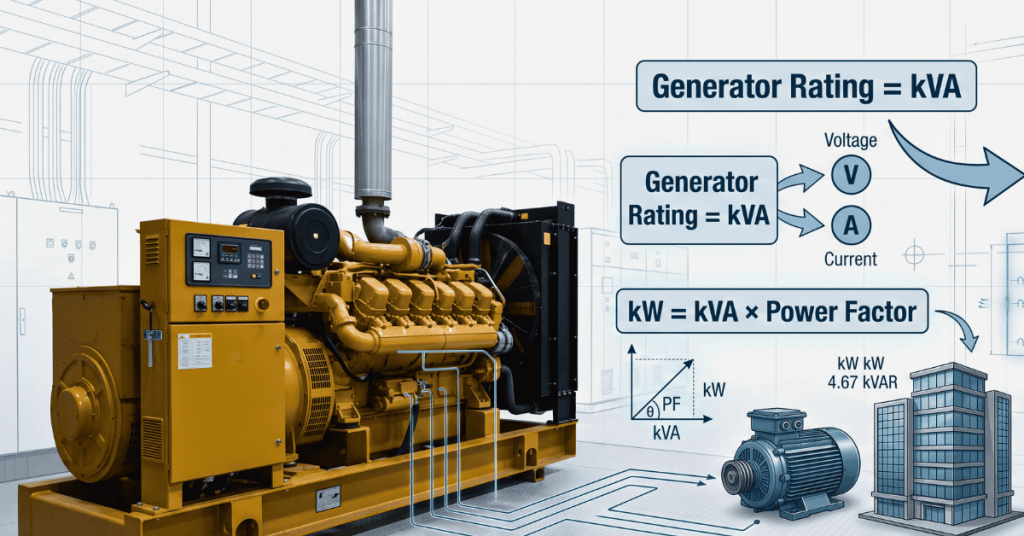
What Does kVA Mean?
kVA stands for Kilovolt-Ampere, which represents apparent power.
Apparent power is the total power supplied by a generator before considering power factor.
The formula is:
kVA = Voltage × Current ÷ 1000 (for single-phase systems)
or
kVA = √3 × Voltage × Current ÷ 1000 (for three-phase systems)
Since voltage and current are measurable regardless of the load, kVA becomes the standard rating unit for generators.
What Does kW Mean?
kW stands for Kilowatt, which represents real or useful power.
Real power performs actual work such as:
- Running motors
- Lighting systems
- Air conditioners
- Pumps
- Compressors
- Industrial machinery
The relationship is:
kW = kVA × Power Factor
Therefore, the actual usable power depends on the connected load’s power factor.
Why Generator Rating in kVA Instead of kW?
This is the most common question among generator buyers.
Manufacturers cannot predict the type of electrical equipment that customers will connect.
Different loads have different power factors.
For example:
| Load Type | Typical Power Factor |
|---|---|
| Resistive Heater | 1.0 |
| LED Lighting | 0.95 |
| Office Equipment | 0.9 |
| Induction Motor | 0.8 |
| Welding Equipment | 0.7–0.8 |
If generators were rated only in kW, the actual current carrying capability could be misunderstood.
By rating generators in kVA, manufacturers specify the maximum electrical capacity independent of load characteristics.
Why Generator Rating in kVA Not in kW?
The generator produces voltage and current, not power factor.
Power factor depends entirely on the connected electrical load.
Since:
Apparent Power (kVA) = Voltage × Current
and
Real Power (kW) = Voltage × Current × Power Factor
the generator manufacturer controls only voltage and current.
The power factor changes according to the customer’s equipment.
Hence, generator ratings are universally expressed in kVA
Why DG Rating in kVA?
Diesel Generator (DG) sets are expected to supply electricity to a wide variety of loads.
For example, a DG may operate:
- Residential buildings
- Hospitals
- Manufacturing plants
- Commercial offices
- Data centers
- Hotels
Each application has a different average power factor.
Using kVA makes the generator suitable for all these applications without assuming a specific load type.
Relationship Between kVA and kW
The relationship is straightforward.
kW = kVA × Power Factor
For most diesel generators, manufacturers assume a standard power factor of 0.8.
Examples:
| Generator Rating | Power Factor | Output in kW |
|---|---|---|
| 125 kVA | 0.8 | 100 kW |
| 250 kVA | 0.8 | 200 kW |
| 500 kVA | 0.8 | 400 kW |
| 1000 kVA | 0.8 | 800 kW |
Related Guide: Calculate DG Energy Consumption
Now that you understand why diesel generator rating in kVA is used instead of kW, you may also want to learn how much electrical energy a generator actually produces during operation. While kVA indicates the generator’s apparent power capacity, the actual electricity generated over time is measured in kilowatt-hours (kWh). Our detailed guide explains How to Calculate DG kWh | How to Calculate kWh from Diesel Generator with simple formulas, practical examples, and step-by-step calculations to help you estimate energy generation, fuel efficiency, and operating costs.
Practical Example
Suppose a generator is rated:
250 kVA
If the connected load has a power factor of 0.8
Output:
250 × 0.8 = 200 kW
If another facility has a power factor of 0.9
Output:
250 × 0.9 = 225 kW
The generator capacity in kVA remains the same.
Only the usable real power changes.
This is exactly why manufacturers avoid rating generators directly in kW.
Advantages of Rating Diesel Generators in kVA
Using kVA offers several benefits.
Universal Standard
It allows comparison between generators from different manufacturers.
Independent of Load
Generator ratings remain accurate regardless of the connected equipment.
Better Generator Selection
Engineers can calculate the required kW based on the site’s actual power factor.
Accurate Current Rating
Since heating inside alternator windings depends on current, kVA directly represents the generator’s electrical capability.
Suitable for Every Industry
Whether used in hospitals, factories, malls, or commercial buildings, the same kVA rating remains valid.
Common Misconceptions
A higher kVA always means higher kW
Not always.
The available kW depends on the operating power factor.
kVA and kW are identical
No.
They become equal only when the power factor is 1.
Every generator has a power factor of 0.8
No.
Manufacturers often use 0.8 as a standard reference, but the actual operating power factor depends on the connected load.
How to Select the Right Generator?
When choosing a DG set:
- Calculate total electrical load in kW.
- Determine the average power factor.
- Convert kW into required kVA.
- Add future expansion capacity.
- Consider motor starting current.
- Check whether standby or prime rating is required.
Selecting the correct kVA ensures reliable operation without overloading the generator.
Frequently Asked Questions (FAQs)
Why diesel generator rating in kVA?
Because the generator supplies voltage and current, while the connected load determines the power factor. Therefore, manufacturers rate generators in kVA instead of kW.
Why generator rating in kVA not in kW?
Power factor varies with different electrical loads. Using kVA provides a universal and accurate rating independent of the load type.
Why DG rating in kVA?
DG sets serve many applications with different power factors. A kVA rating ensures one standard specification suitable for all users.
Why generator rating in kVA instead of kW?
kVA reflects the generator’s maximum electrical output capability. The actual usable power in kW depends on the load’s power factor.
Can I convert kVA into kW?
Yes.
Formula:
kW = kVA × Power Factor
For example:
100 kVA × 0.8 = 80 kW
Still have questions about diesel generators? Our in-depth guide Why Diesel Generator is Used: Why its Rating in kVA, Why Power Factor, Why it is Expensive, Causes not to Start covers everything from the basic working principle of diesel generators to why generators are rated in kVA instead of kW, how power factor affects generator performance, why DG sets cost more than other power solutions, and the most common reasons a diesel generator may fail to start. Reading both articles will give you a complete understanding of diesel generator selection, operation, and troubleshooting.
Conclusion
Understanding why diesel generator rating in kVA helps eliminate one of the most common misconceptions in power generation. A diesel generator is rated in kVA because it reflects the total electrical power the alternator can deliver, regardless of the connected load’s power factor. Since power factor varies from one application to another, using kVA provides a consistent, universal, and technically accurate rating.
When selecting a DG set, always calculate your load requirements in kW, determine the expected power factor, and then convert the result into the required kVA. This approach ensures proper generator sizing, reliable performance, and efficient operation across residential, commercial, and industrial applications.