Diesel Generator (DG) sets are widely used across India to provide backup power during electricity outages. From residential societies and hospitals to factories, commercial buildings, telecom towers, hotels, and construction sites, DG sets ensure uninterrupted power supply whenever the grid fails. However, along with reliable power generation comes another challenge—noise pollution.
To reduce excessive noise from diesel generators, the Central Pollution Control Board (CPCB) has prescribed specific noise standards under the Environment (Protection) Rules, 1986. These rules define the maximum permissible noise level, acoustic enclosure requirements, testing procedures, certification process, and responsibilities of manufacturers as well as DG set users.
Whether you are planning to purchase a new diesel generator, install one at your facility, or simply want to understand the latest CPCB regulations, this guide explains everything in simple language without using complex legal terms.
What Are CPCB Noise Standards for DG Sets?
CPCB noise standards are government regulations designed to control the sound produced by diesel generator sets. These standards ensure that DG sets operate within acceptable noise limits to protect people from excessive sound exposure and reduce environmental noise pollution.
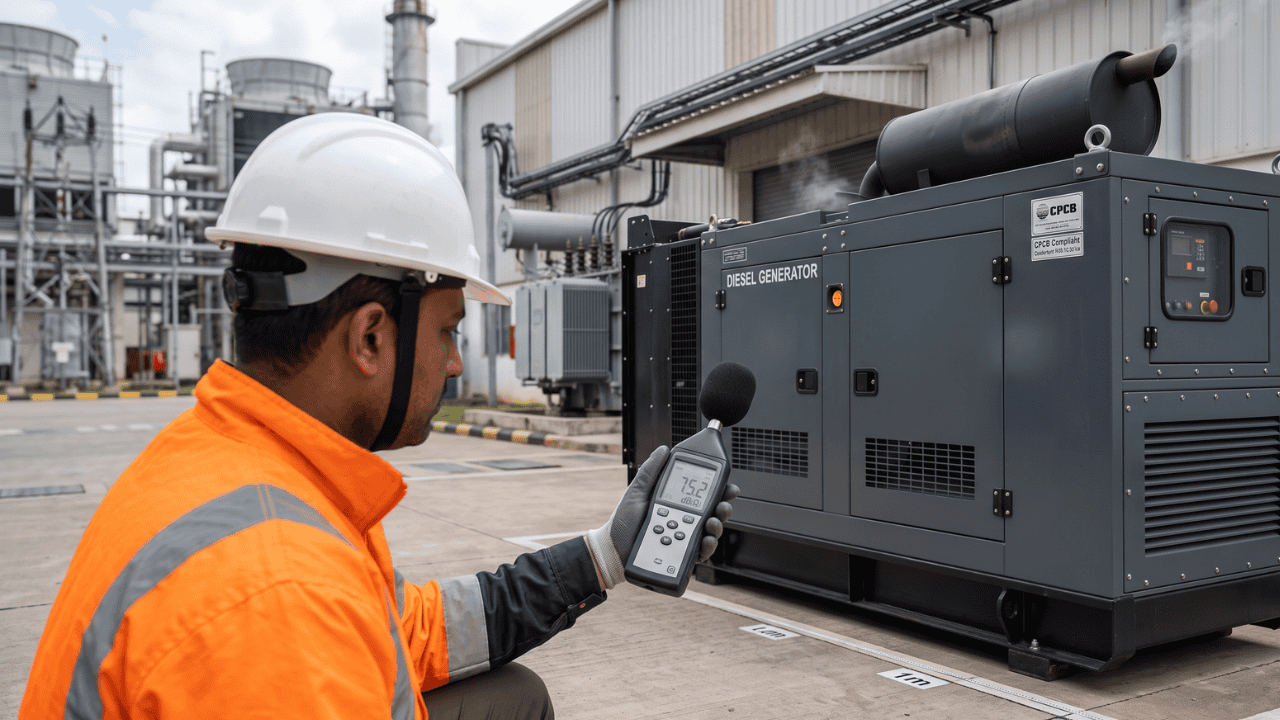
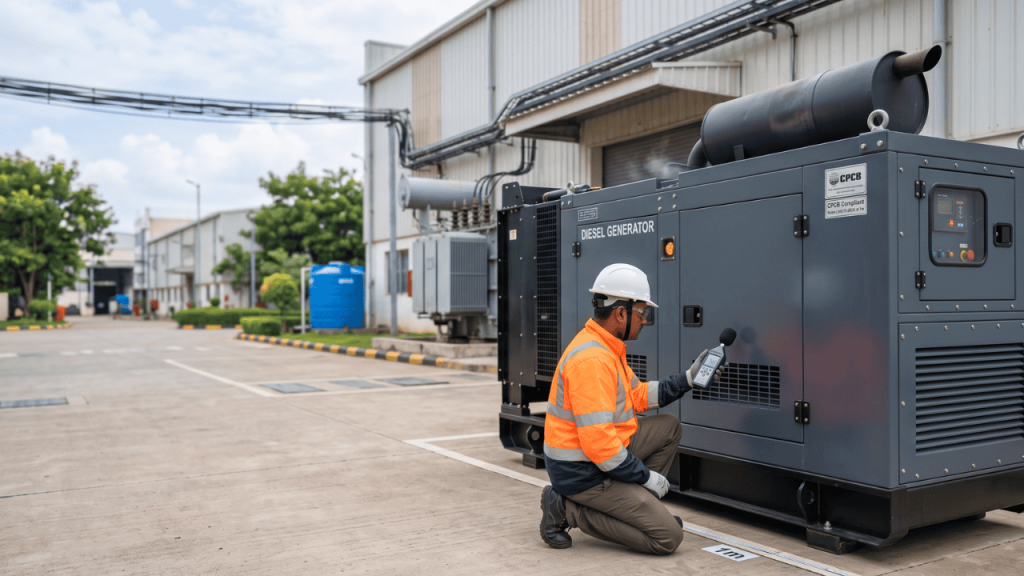
According to CPCB regulations, new diesel generator sets up to 1000 kVA must not exceed a sound pressure level of 75 dB(A), measured at a distance of one metre from the acoustic enclosure. This requirement applies to generators manufactured or imported for use in India within the scope of the regulations.
The objective of these standards is not only to reduce public inconvenience but also to encourage manufacturers to design quieter, more efficient generator sets.
Why Are Noise Standards Important?
Continuous exposure to high noise levels can affect both human health and the surrounding environment. Loud diesel generators can disturb nearby residents, interfere with workplace communication, reduce productivity, and even cause hearing-related problems when proper protection is not used.
By enforcing uniform noise limits, CPCB encourages manufacturers to improve generator design while ensuring that users receive safer and quieter equipment. Noise control also helps industries and commercial establishments comply with environmental regulations and avoid complaints from neighbouring properties.
Latest CPCB Noise Limit for DG Sets
The most important requirement under the CPCB guidelines is the permissible noise limit.
| DG Set Category | Maximum Permissible Noise Level |
|---|---|
| Diesel Generator Sets up to 1000 kVA | 75 dB(A) at 1 metre from the enclosure surface |
This limit applies to new DG sets covered under the applicable CPCB notification. Manufacturers are required to supply these generators with an integral acoustic enclosure designed specifically to meet the prescribed noise limit.
It is important to understand that the noise level is measured from the surface of the acoustic enclosure, not from the engine or exhaust pipe directly.
Which DG Sets Are Covered?
The CPCB noise standards apply to most commonly used diesel generators with a rated output of up to 1000 kVA.
Some common generator ratings covered under these regulations include:
- 5 kVA
- 7.5 kVA
- 10 kVA
- 15 kVA
- 20 kVA
- 25 kVA
- 30 kVA
- 40 kVA
- 62.5 kVA
- 82.5 kVA
- 100 kVA
- 125 kVA
- 160 kVA
- 200 kVA
- 250 kVA
- 320 kVA
- 500 kVA
- 625 kVA
- 750 kVA
- 1000 kVA
Whether a generator is used in a residential complex, manufacturing unit, office building, shopping mall, educational institution, healthcare facility, or infrastructure project, it must comply with applicable CPCB requirements before being sold or installed.
The regulations do not apply to DG sets manufactured exclusively for export or sample units that are not intended for sale within India.
Acoustic Enclosure – A Mandatory Requirement
One of the most significant requirements under CPCB regulations is the use of an integral acoustic enclosure.
Modern DG sets are supplied with specially designed soundproof enclosures that help reduce engine, alternator, cooling fan, and mechanical noise. Instead of relying on external soundproofing after installation, manufacturers are expected to provide the enclosure as part of the generator itself.
A well-designed acoustic enclosure offers several advantages:
- Reduces operating noise significantly.
- Protects internal components from dust and rain.
- Improves overall safety.
- Enhances equipment life.
- Helps maintain compliance with CPCB regulations.
The enclosure should be properly ventilated to ensure adequate cooling while maintaining effective noise reduction. Damaged insulation panels, broken doors, missing rubber seals, or poorly maintained ventilation openings can increase noise levels considerably.
Exhaust Muffler Requirements
Apart from engine noise, exhaust noise is another major contributor to overall sound levels.
For this reason, CPCB guidelines require diesel generators to be fitted with a suitable exhaust muffler capable of reducing exhaust noise effectively. A properly selected muffler minimizes sound without creating excessive back pressure on the engine.
Regular inspection of the exhaust system is equally important. Loose joints, damaged silencers, rusted pipes, or exhaust leaks can significantly increase generator noise and should be repaired immediately.
Responsibilities of DG Set Manufacturers
Manufacturers have several responsibilities before a generator reaches the customer.
They must:
- Design generators that comply with CPCB noise limits.
- Provide an integral acoustic enclosure.
- Supply an appropriate exhaust muffler.
- Obtain Type Approval from an authorised certification agency.
- Obtain annual Conformity of Production (COP) certification.
- Affix the required compliance label on every generator.
- Maintain consistent manufacturing quality.
A DG set that does not meet these requirements should not be sold in the Indian market. Compliance begins at the manufacturing stage itself, making it the manufacturer’s responsibility to ensure every approved model satisfies the prescribed standards.
Responsibilities of DG Set Owners
Compliance does not end once the generator is purchased. Owners and users also have an important role in maintaining acceptable noise levels.
Every DG set should be installed exactly as recommended by the manufacturer. Proper foundation, sufficient ventilation, correct exhaust routing, and regular preventive maintenance all contribute to quieter operation.
Users should also avoid making unauthorised modifications that could affect the performance of the acoustic enclosure or exhaust system. Even a certified generator may produce excessive noise if maintenance is neglected or components are replaced with non-standard parts.
Type Approval and Conformity of Production (COP)
To ensure that every DG set available in the market complies with the prescribed noise limits, CPCB has established a certification system known as Type Approval and Conformity of Production (COP).
Type Approval is issued after an authorised testing agency verifies that a particular DG set model satisfies the applicable noise standards. The approval is generally granted to a product family after testing the parent model under specified conditions.
However, obtaining Type Approval once is not sufficient. Manufacturers must also obtain Conformity of Production (COP) certification every year. COP verification confirms that the generators being produced continue to meet the same noise standards as the originally approved model. This prevents manufacturers from changing designs or materials that may increase noise levels after receiving initial approval.
Without valid Type Approval and COP certification, a DG set should not be manufactured, imported, sold, or used where these regulations apply.
Authorised Certification Agencies
CPCB has authorised several organisations to carry out testing and certification of diesel generator sets.
These include:
| Certification Agency | Location | Official Website |
|---|---|---|
| Automotive Research Association of India (ARAI) | Pune, Maharashtra | www.araiindia.com |
| National Physical Laboratory (NPL) | New Delhi | www.nplindia.in |
| Naval Science & Technological Laboratory (NSTL) | Visakhapatnam, Andhra Pradesh | DRDO – NSTL |
| Fluid Control Research Institute (FCRI) | Palakkad, Kerala | www.fcriindia.com |
| National Aerospace Laboratories (NAL) | Bengaluru, Karnataka | www.nal.res.in |
These agencies perform technical evaluations, verify compliance with CPCB requirements, and issue the necessary certificates after successful testing.
How Is DG Set Noise Tested?
Noise testing is carried out under controlled conditions to ensure accurate and consistent results.
Before the actual noise measurement begins, the DG set is operated at its rated load for a specified period. During testing, several parameters are checked, including cooling performance, exhaust back pressure, and operating conditions. Noise is then measured according to the prescribed testing procedure.
Only when the measured noise level remains within the permissible limit can the DG set qualify for certification. Manufacturers must ensure that every component, including the engine, alternator, acoustic enclosure, ventilation system, and exhaust muffler, functions correctly during testing.
Compliance Label Requirements
Every compliant DG set should carry a durable label containing important information.
The label generally includes:
- Manufacturer or supplier name
- Statement confirming compliance with Environment (Protection) Rules, 1986
- Noise limit information
- Type Approval Certificate Number
- Date of manufacture
This label helps users, inspectors, and regulatory authorities verify that the generator has been manufactured according to applicable CPCB requirements.
Best Practices for Reducing DG Set Noise
Even after purchasing a CPCB-compliant generator, proper installation and maintenance are essential for long-term noise control.
Follow these practical recommendations:
- Purchase only CPCB-certified DG sets.
- Never remove or modify the acoustic enclosure.
- Inspect door seals and insulation regularly.
- Replace damaged silencers immediately.
- Tighten loose bolts and vibration mounts.
- Avoid operating the generator with enclosure doors open.
- Carry out preventive maintenance at recommended intervals.
- Install the DG set on a proper vibration-isolated foundation.
- Keep the cooling air passages clean.
- Use only genuine replacement parts.
Regular servicing not only reduces noise but also improves fuel efficiency and increases equipment life.
Common Reasons Why DG Sets Fail Noise Compliance
Many generators become noisier over time because of poor maintenance rather than poor manufacturing.
Some common reasons include:
- Damaged acoustic enclosure
- Missing insulation material
- Worn anti-vibration mounts
- Exhaust leakage
- Rusted or damaged silencers
- Improper installation
- Poor maintenance
- Low-quality aftermarket spare parts
- Unauthorized modifications
Most of these issues can be prevented through routine inspection and timely servicing.
Difference Between Noise Standards, Emission Norms and Stack Height
Many people confuse these three requirements, but they regulate different aspects of DG set operation.
| Requirement | Purpose |
|---|---|
| CPCB Noise Standards | Controls sound generated by the DG set |
| CPCB Emission Norms | Controls exhaust pollutants emitted by the engine |
| CPCB Stack Height Norms | Ensures exhaust gases disperse safely into the atmosphere |
A DG set should comply with all applicable environmental regulations, not just one of them.
For detailed information about chimney height requirements, read our guide on CPCB Norms for DG Set Stack Height
If you are planning to reduce emissions from existing diesel generators, you may also find our article on Top CPCB Authorised RECD Manufacturers in India useful
CPCB Noise Standards pdf Download Free
While this article simplifies the technical requirements for easier understanding, manufacturers, consultants, and project engineers should always refer to the official CPCB publication before making design or compliance decisions.
The latest official document can be downloaded from the CPCB Guidelines section:
Frequently Asked Questions
What is the CPCB noise limit for DG sets?
The maximum permissible noise level for new DG sets up to 1000 kVA is 75 dB(A) measured at one metre from the acoustic enclosure surface.
Is an acoustic enclosure mandatory?
Yes. CPCB requires new DG sets covered under the regulations to be supplied with an integral acoustic enclosure.
Which DG sets are covered under CPCB noise standards?
Most diesel generator sets up to 1000 kVA manufactured or imported in India are covered, except certain exempt categories such as export-only units.
Is Type Approval compulsory?
Yes. Every applicable DG set model must obtain Type Approval before it can be sold in India.
What is COP certification?
COP (Conformity of Production) confirms that production models continue meeting CPCB noise standards every year.
Can I remove the acoustic enclosure after installation?
No. Removing or modifying the enclosure may increase noise levels and affect compliance.
Does regular servicing reduce noise?
Yes. Proper maintenance helps maintain both performance and acceptable noise levels throughout the generator’s service life.
Does CPCB regulate exhaust emissions as well?
Yes. Noise regulations and emission regulations are separate requirements, and both may apply depending on the generator model.
Who performs noise testing?
Only CPCB-authorised certification agencies such as ARAI, NPL, NSTL, FCRI, and NAL conduct official testing and certification.
Can an old DG set become noisier?
Yes. Worn engine components, damaged silencers, poor maintenance, or deteriorated acoustic insulation can increase operating noise over time.
Conclusion
CPCB noise standards have significantly improved the quality and environmental performance of diesel generator sets used across India. By limiting noise levels, mandating acoustic enclosures, and introducing Type Approval and Conformity of Production certification, the regulations help protect public health while encouraging manufacturers to build quieter and more efficient generators.
Whether you are purchasing a new DG set, installing one for your facility, or managing an existing generator fleet, understanding these requirements will help you make informed decisions and remain compliant with environmental regulations. Always choose a CPCB-certified generator, follow the manufacturer’s installation recommendations, and carry out regular preventive maintenance to ensure reliable, safe, and quieter operation for years to come.