Wondering how to calculate DG capacity?
Use our free DG Set Capacity Calculator to estimate the correct diesel generator size based on your connected electrical load, power factor, and future expansion. This calculator also recommends the nearest standard DG set rating, making it easier to select the right generator for residential, commercial, and industrial applications.
DG Set Sizing & Capacity Calculator
Estimate the required Diesel Generator capacity based on your connected load.
1. Enter Connected Load
2. Recommended DG Set Capacity
Calculation Breakdown
Note: Calculations assume a standard Generator Power Factor (PF) of 0.8. It is highly advised not to run a DG set consistently above 80% of its rated capacity.
How to Calculate DG Capacity?
Selecting the correct diesel generator (DG) capacity is essential to ensure reliable power backup, fuel efficiency, and long service life. An undersized generator may trip during peak demand, while an oversized generator increases capital cost and fuel consumption.
The simplest way to calculate DG capacity is:
DG Capacity (kVA) = Connected Load (kW) ÷ Power Factor
If future load expansion is expected, include a safety margin of 20% to 25% before selecting the nearest standard DG rating.
Use the DG Set Capacity Calculator above to instantly determine the recommended generator size based on your electrical load.
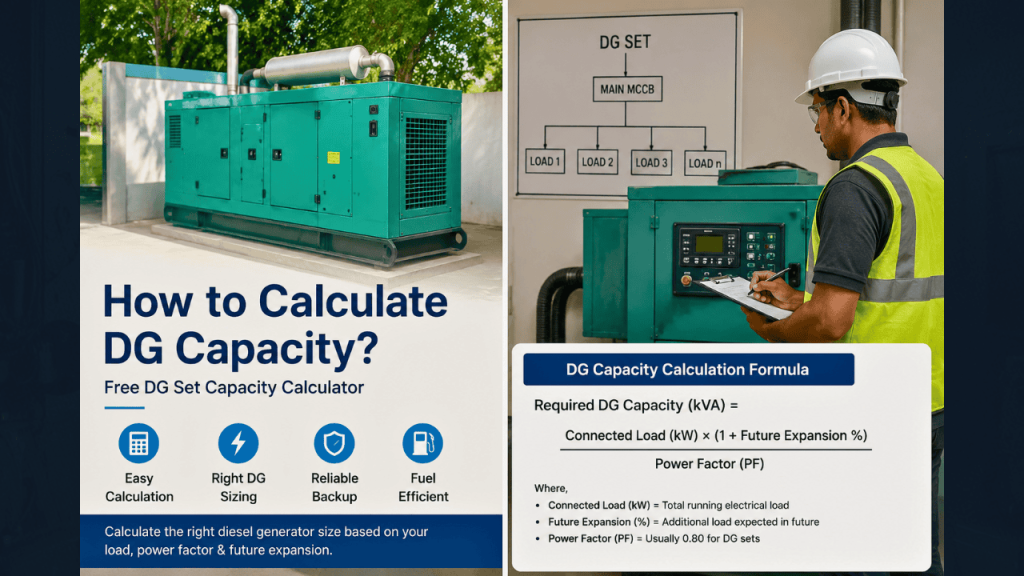
DG Capacity Calculation Formula
For most commercial and industrial applications, use the following formula:
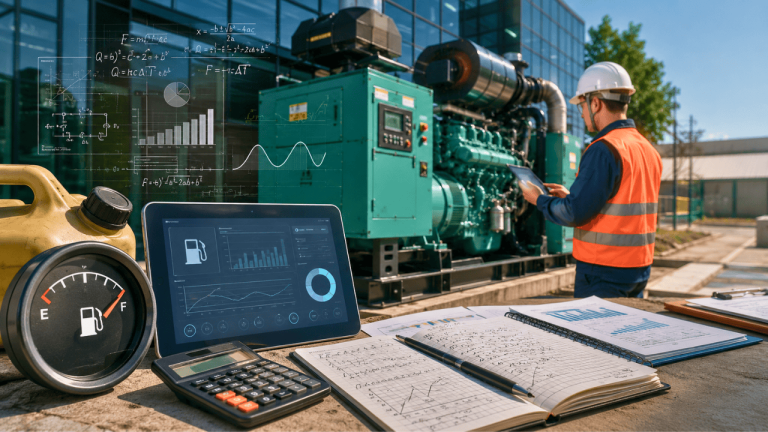
Required DG Capacity (kVA) = (Connected Load × (1 + Future Expansion)) ÷ Power Factor
Where:
- Connected Load (kW) = Total running electrical load
- Future Expansion = Additional capacity planned (typically 20–25%)
- Power Factor = Usually 0.8 for diesel generators
Example: How to Calculate DG Capacity
Suppose your facility has:
- Connected Load = 60 kW
- Power Factor = 0.8
- Future Expansion = 20%
Step 1
Adjusted Load
60 × 1.20 = 72 kW
Step 2
Required DG Capacity
72 ÷ 0.8 = 90 kVA
Step 3
Nearest Standard Rating
The next available standard DG size is:
100 kVA DG Set
Therefore, a 100 kVA diesel generator is recommended.
Standard DG Set Ratings
| DG Rating (kVA) | Typical Application |
|---|---|
| 5 | Home Backup |
| 7.5 | Small House |
| 10 | Small Office |
| 15 | Shops |
| 20 | Commercial Office |
| 25 | Small Commercial Building |
| 30 | Restaurants |
| 40 | Apartments |
| 50 | Medium Commercial Building |
| 62.5 | Clinics |
| 75 | Small Factory |
| 82.5 | Industrial Workshop |
| 100 | Factory |
| 125 | Manufacturing Unit |
| 160 | Industrial Plant |
| 200 | Large Factory |
| 250 | Commercial Complex |
| 320 | Hospitals |
| 380 | Data Centres |
| 500 | Large Manufacturing |
| 625 | Process Industries |
| 750 | Infrastructure Projects |
| 1000 | Large Industrial Plant |
| 1250 | IT Parks |
| 1500 | Airports |
| 2000 | Utility Applications |
| 2500 | Power Stations |
Factors Affecting DG Capacity Selection
The correct diesel generator capacity depends on several engineering factors:
- Total connected electrical load
- Running load versus starting load
- Motor starting current
- Future expansion
- Power factor
- Load diversity
- Ambient temperature
- Altitude
- Voltage drop requirements
- Continuous or standby operation
Professional electrical consultants often consider all of these parameters before finalizing generator capacity.
Common Mistakes While Calculating DG Capacity
Avoid these common errors:
- Ignoring motor starting load
- Assuming a power factor of 1.0
- Forgetting future expansion
- Selecting the exact calculated rating without reserve capacity
- Oversizing the generator unnecessarily
- Ignoring manufacturer derating guidelines
Frequently Asked Questions
How do I calculate DG capacity?
Divide the connected electrical load (kW) by the generator power factor (normally 0.8) and include an additional 20–25% future expansion before selecting the nearest standard DG rating.
Why is DG capacity expressed in kVA instead of kW?
Diesel generators are rated in kVA because they supply both active power (kW) and reactive power (kVAR). The relationship depends on the operating power factor.
Which power factor should I use?
Most standard diesel generators are rated at 0.8 power factor unless specified otherwise by the manufacturer.
Should I add future expansion?
Yes. Most engineers recommend adding 20% to 25% future expansion while sizing a new DG set.
Can I use this calculator for home generators?
Yes. The calculator can be used for residential, commercial, office, hospital, industrial, and institutional generator sizing.
Which DG rating should I choose?
Always select the next higher standard DG rating after calculating the required capacity.
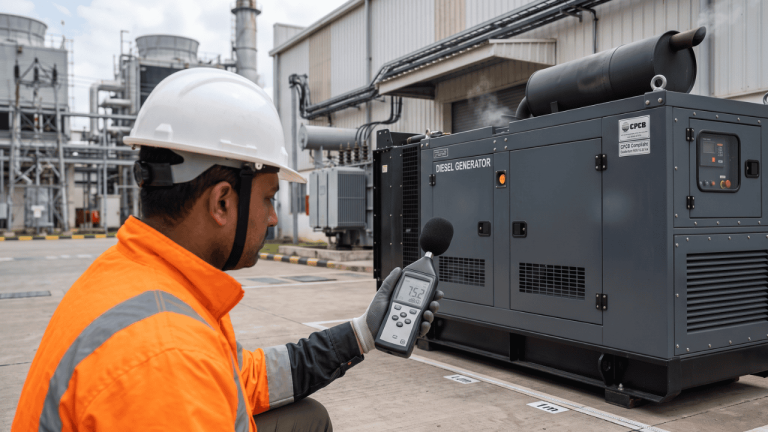
Is there any CPCB Noise Standards for DG Sets?
Yes, please read complete guide: CPCB Noise Standards for DG Sets: Latest Noise Limits, Guidelines, Testing and Compliance
Conclusion
Choosing the correct DG capacity improves reliability, reduces fuel consumption, prevents generator overloading, and extends engine life. By considering connected load, power factor, and future expansion, you can accurately determine the recommended generator size. Use the DG Set Capacity Calculator above to quickly estimate the required DG rating and compare it with standard generator sizes before making a purchase.
CPCB Noise Standards for DG Sets: Latest Noise Limits, Guidelines, Testing and Compliance