How to Calculate Diesel Generator Fuel Consumption: The Complete Guide
Diesel Generator Fuel Calculator
Estimated Consumption Results
Running a diesel generator (DG) is a smart way to ensure uninterrupted power, but managing the operational costs can quickly turn into a guessing game. If you have ever looked at a backup power setup and wondered exactly how much fuel it is burning through, you are not alone.
Calculating diesel generator fuel consumption doesn't require an advanced engineering degree. Whether you are budgeting for an industrial facility, setting up a backup system for a commercial building, or trying to manage a mobile job site, knowing your consumption metrics is key to avoiding unexpected fuel shortages and managing your budget.
Let’s break down exactly how to calculate your DG set fuel consumption, the exact formula to use, and how operational loads change your math.
The Golden Rule of Generator Fuel Consumption
Before diving into the math, it helps to understand a foundational industry rule of thumb: A diesel generator operating under standard conditions consumes roughly 0.26 to 0.28 liters of diesel per kilowatt (kW) of power produced, per hour.
However, fuel consumption is never a flat line. Your actual consumption changes dynamically based on three main variables:
- The size (capacity) of the generator: Usually measured in kVA or kW.
- The operational load factor: How hard the generator is actually working (e.g., running at 50% capacity vs. 100% full capacity).
- Total runtime: How many hours the generator is kept running.
Diesel Generator Fuel Consumption Calculator
Use our interactive tool below to instantly estimate your generator's fuel needs per hour and across your total runtime. You can toggle between kVA and kW ratings and adjust the load factor to match your real-world usage.
How to Calculate Diesel Generator Fuel Consumption Formula
If you want to understand the exact math happening behind the dashboard, you can use the standard dg set fuel consumption formula.
To use this formula accurately, you first need to make sure your generator's capacity is measured in kilowatts ($kW$). If your manufacturer lists the size in kilovolt-amperes ($kVA$), you must first convert it using a standard power factor (typically $0.8$ for diesel engines).
Step 1: Convert kVA to kW (If Needed)
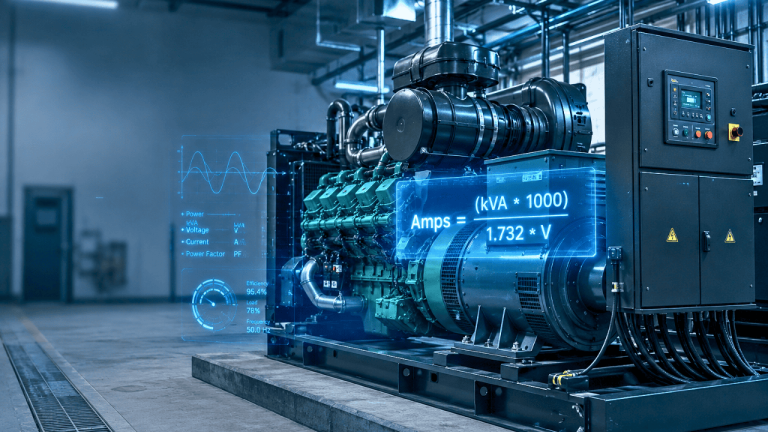
$$\text{Generator Capacity (kW)} = \text{Capacity (kVA)} \times 0.8$$
Step 2: Apply the Consumption Formula
Once you have the capacity in kW, use this formula to calculate the consumption per hour:
$$\text{Fuel Consumption (Liters/Hour)} = \text{Total kW Output} \times \text{Specific Fuel Consumption Factor}$$
The Specific Fuel Consumption Factor shifts depending on how heavily loaded the generator is. Because internal combustion engines lose thermal efficiency when idling or running under light stress, they actually use slightly more fuel per kW generated when running at a lower capacity.
- At 100% Full Load: Multiply by $\sim 0.26$
- At 75% Prime Load: Multiply by $\sim 0.27$
- At 50% Half Load: Multiply by $\sim 0.29$
A Worked Example:
Let's say you are running a 100 kVA generator at a typical 75% load factor.
- First, convert kVA to kW: $100 \times 0.8 = 80 \text{ kW}$ max capacity.
- Next, find your active running output: $80 \text{ kW} \times 0.75 = 60 \text{ kW}$ of active demand.
- Finally, apply the 75% load factor multiplier: $60 \text{ kW} \times 0.27 = 16.2 \text{ Liters per hour}$.
Estimating Diesel Generator Consumption Per Hour By Size
If you just need a quick estimate without running a manual calculation, here is a handy reference chart. This details the average diesel consumption in generator models across common commercial sizes running at a standard 75% load factor.
| Generator Size (kVA) | Equivalent Size (kW) | Est. Fuel Consumption at 75% Load (Liters/Hour) |
| 20 kVA | 16 kW | ~3.2 Liters/hr |
| 45 kVA | 36 kW | ~7.3 Liters/hr |
| 60 kVA | 48 kW | ~9.7 Liters/hr |
| 100 kVA | 80 kW | ~16.2 Liters/hr |
| 200 kVA | 160 kW | ~32.4 Liters/hr |
| 500 kVA | 400 kW | ~81.0 Liters/hr |
Pro Tip: Running a generator below 30% load capacity for extended periods can cause a mechanical issue known as "wet stacking" (where unburnt fuel accumulates in the exhaust system). To optimize your dg efficiency, aim to keep your equipment running between 50% and 80% of its rated capacity.
Frequently Asked Questions
Why does my actual fuel use differ from the formula?
The dg set fuel consumption calculator provides a highly accurate engineering estimate, but real-world factors like extreme ambient temperatures, high altitudes, poorly maintained air filters, and the age of the engine can cause variations of 5% to 10% in actual fuel usage. Always consult your specific manufacturer's technical data sheet (such as Cummins, CAT, or Perkins) for exact model specs.
Does a generator use less fuel with no load?
Yes, a generator running with zero load (idling) consumes significantly less total fuel than one under full load. However, its efficiency drops to zero because it is burning fuel simply to keep the engine turning without doing any meaningful electrical work.
How do I calculate diesel generator efficiency?
Electrical efficiency is calculated by dividing the total electrical energy output (in kilowatt-hours) by the chemical energy content of the diesel fuel consumed over that same time period. For most modern diesel generators, this net efficiency sits right around 35% to 42%, with the rest of the energy being lost as heat.