If you are managing a facility, running a commercial complex, or setting up a backup power system for your home, knowing your generator’s exact limits isn’t just technical trivia—it is a critical operational safety check.
Overloading a Diesel Generator (DG) leads to unexpected tripping, voltage drops, and severe engine wear. Underloading it, or “light loading,” causes fuel waste and wet stacking (unburnt fuel buildup in the exhaust).
To help you find your exact electrical requirements instantly, use our interactive tool below before diving into the step-by-step conversion formulas.
How To Calculate Dg Load – How To Calculate Dg Full Load Current
DG Load & Full Load Current Calculator
Why You Need to Know Your Generator’s Real Capacity
When people search for information on generator capacity, they usually face two core challenges:
- The Sizing Problem: You have a specific electrical load and need to buy or rent the correct size DG set.
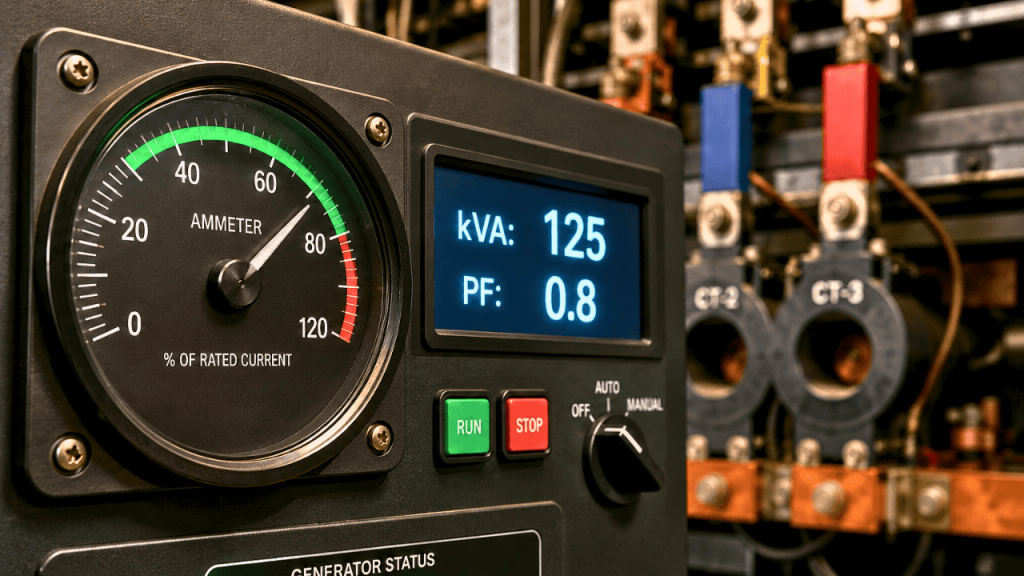
- The Current Check: You already have a generator (e.g., a 125 kVA unit) and need to ensure your connected appliances do not cross its absolute Amperage limit.
Electrical loads are generally measured in Kilowatts (kW) or Amperes (Amps), but industrial diesel generators are rated in Kilovolt-Amperes (kVA). Understanding how these units interact ensures you never compromise your backup power supply.
The Simple Formula to Calculate DG Full Load Current
To find the maximum current (Amps) your generator can handle per phase, the calculation differs depending on whether your system is single-phase or three-phase.
Three-Phase Generator Formula
Three-Phase Generator Formula
Most commercial and industrial setups use a 3-phase supply, typically running at 415 Volts.
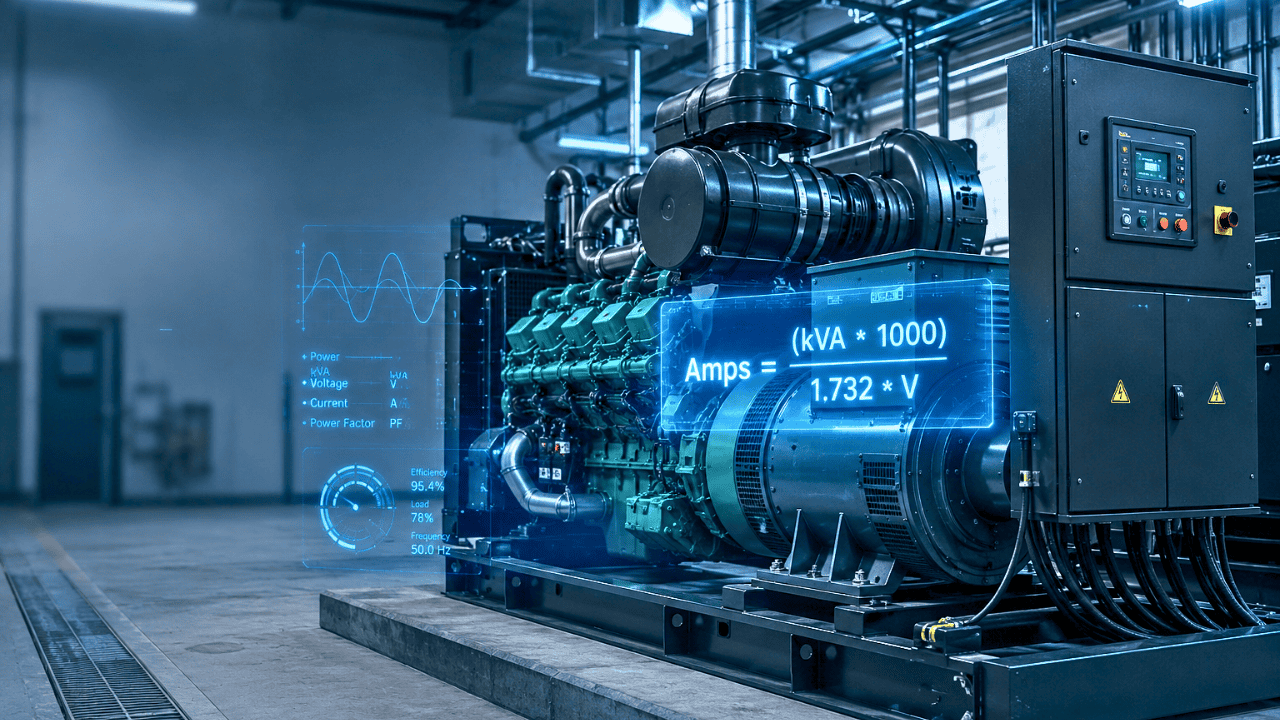
Because the square root of 3 (√3) is roughly 1.732, the standard formula for a typical 415V system simplifies to:
For a standard 415V, 3-phase system, your full load current is always roughly 1.39 multiplied by the kVA rating.
*Per phase capacity under ideal conditions.
Interactive Three-Phase Current Calculator
Input your generator's kVA rating and operating voltage below to dynamically calculate the full load current using the formula: Amps = (kVA × 1000) / (1.732 × V).
Single-Phase Generator Formula
Single-Phase Generator Formula
For residential or smaller domestic generators operating on a standard single-phase 230V line, the calculation drops the phase multiplier entirely:
Enter your single-phase generator capacity and actual operating line voltage below:
*Total continuous line current available at designated voltage.
For residential or smaller domestic generators operating on a standard single-phase 230V line, the calculation drops the phase multiplier:
Converting kW to kVA: Understanding Power Factor
Converting kW to kVA: Understanding Power Factor
A common point of confusion when learning how to calculate dg load is the difference between real power (kW) and apparent power (kVA).
Generators are rated in kVA because they must support both the energy consumed by an appliance (kW) and the magnetic fields required by inductive loads like motors, air conditioners, and pumps. The efficiency of this relationship is called the Power Factor (PF).
Most standard industrial diesel generators are designed around a baseline power factor of 0.8.
For example, if you have a total facility load of 80 kW, your minimum required generator capacity under perfect conditions is calculated as: 80 kW / 0.8 PF = 100 kVA.
*Change either input or adjust the slider to instantly view updated conversion values.
The 80% Rule: Calculating Safe Operating DG Capacity
You should never design a system to run your diesel generator at 100% of its rated capacity for continuous operations. Standard industry engineering guidelines recommend running a DG set between 70% to 80% of its maximum full load capacity.
Operating within this window provides crucial benefits:
- Handles Surge Currents: Allows enough headroom for heavy electric motors to draw high starting currents without tripping the main breaker.
- Optimizes Fuel Efficiency: Diesel engines run most efficiently when loaded heavily enough to reach stable operating temperatures, but not strained to their physical limits.
- Extends Equipment Lifespan: Reduces internal component thermal stress, drastically cutting down on maintenance overhead.
Calculating Safe Operating Capacity
To calculate your safe maximum continuous operating load in kW, multiply your total kVA capacity by the standard power factor (0.8), and then scale it down to an 80% load capacity limit to safeguard the machinery:
Enter your generator's rated kVA size to determine your peak safe continuous loading threshold:
*Running continuously above this target kW risks thermal engine stress and electrical overload tripping.
Step-by-Step Guide to Sizing Your Generator Load
If you are preparing to map out your facility's requirements manually, follow this sequential matching protocol:
- List All Connected Equipment: Note down every appliance, machine, light, and motor that must run on backup power simultaneously.
- Identify Running vs. Starting Watts: Pay close attention to items with compressors or motors (like HVAC units or industrial pumps). These require up to three times their normal running wattage just to start up.
- Convert Amps to kW: If your equipment tags only show Amps, convert them using the standard formula: $\text{kW} = (\text{Amps} \times \text{Volts} \times \text{PF}) / 1000$ for single-phase systems.
- Sum the Total Active Load: Add up your continuous running loads and factor in the single largest motor starting spike.
- Apply the Safety Buffer: Divide your final kW requirement by 0.8 to convert it to kVA, then divide by 0.8 again to ensure your generator maintains a healthy 20% safety headroom.
Frequently Asked Questions About DG Load Calculations
What is the formula for DG load calculation?
Basic DG Load & Capacity Formulas
The basic formula to calculate the total active load a Diesel Generator (DG) can support in Kilowatts (kW) is:
To find the required generator capacity in Kilovolt-Amperes (kVA) based on your equipment's total kW load, invert the formula:
Modify either field below to calculate the corresponding metric based on a standard 0.8 Power Factor:
(Note: A standard power factor of 0.8 is applied to most industrial diesel generators).
How to calculate dg full load current?
Full Load Current Breakdown
To calculate the full load current (Amperes) of a 3-phase diesel generator, use the following core formula:
For a standard 415V 3-phase generator, this simplifies cleanly to multiplying the kVA rating by 1.39. For a single-phase 230V generator, you drop the phase multiplier and divide the total Volt-Amps (kVA × 1000) directly by 230.
How to calculate a generator load?
How to Calculate a Generator Load Dynamically
To calculate your total generator load manually, list the running wattage of all electrical items that must operate simultaneously. For any motorized equipment (like air conditioners or water pumps), multiply their running wattage by 3 to account for initial starting surges. Sum all these values together in Kilowatts (kW), and divide the total by 0.8 to find your exact baseline kVA requirement.
Input your single appliance load below to analyze how starting surges affect your required baseline generator metrics:
*Motorized configurations automatically scale the running value by 3x to protect your generator from severe starting surge currents.
To calculate your total generator load manually, list the running wattage of all electrical items that must operate simultaneously. For any motorized equipment (like air conditioners or water pumps), multiply their running wattage by 3 to account for initial starting surges. Sum all these values together in Kilowatts (kW), and divide the total by 0.8 to find your exact baseline kVA requirement.
How to calculate DG capacity?
To calculate the total required DG capacity for a facility, take your maximum calculated load in kW and apply a 20% safety margin so the engine does not run under constant stress. The final engineering formula is mentioned below
Calculating Total Required DG Capacity
To calculate the total required DG capacity for a facility, take your maximum calculated load in kW and apply a 20% safety margin so the engine does not run under constant stress. The final engineering formula is:
This calculation ensures your generator operates within its ideal, fuel-efficient sweet spot of 70% to 80% total continuous load capacity.
Enter your total connected load in Kilowatts to compute your ideal target generator size:
*Calculated recommendation leaves exactly 20% cushion to safely handle inductive motor startup spikes.
This calculation ensures your generator operates within its ideal, fuel-efficient sweet spot of 70% to 80% total continuous load capacity.