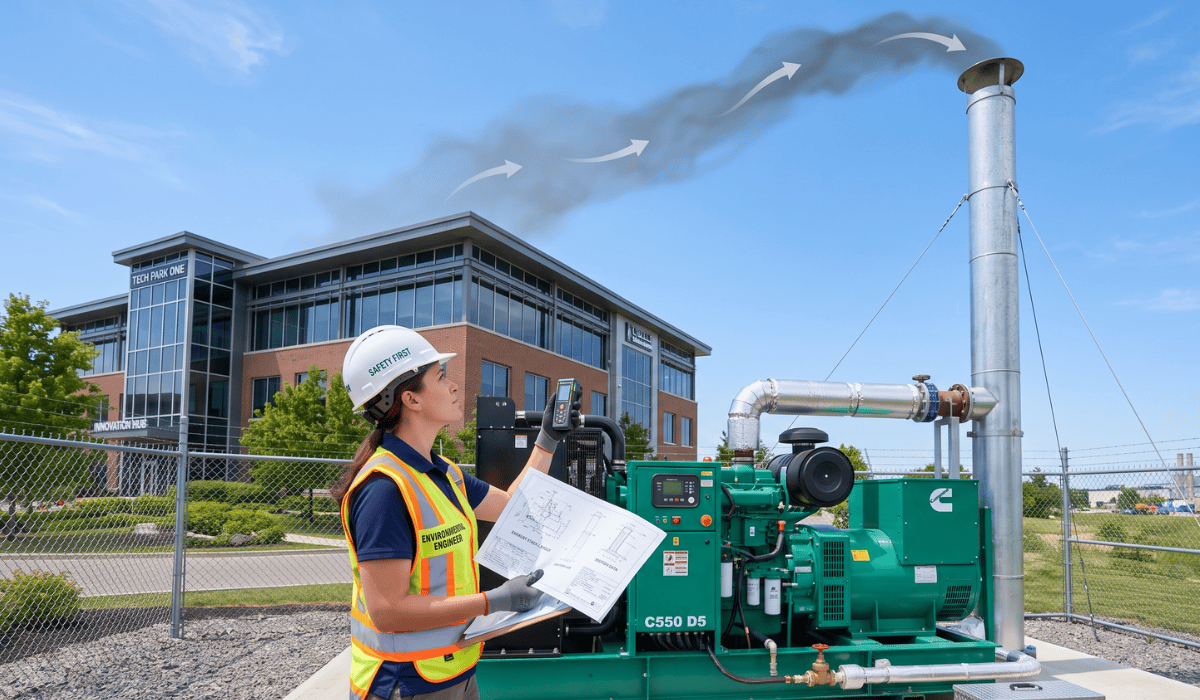
An environmental engineer measuring a diesel generator exhaust stack to calculate the correct DG stack height using the CPCB-recommended formula for safe emission dispersion.
Calculate DG Stack Height using the formula:
H = h + (0.2 × √KVA)
Calculation Result
DG Capacity:
kVA
Building Height:
m
√KVA:
0.2 × √KVA:
m
Required DG Stack Height
metres
Formula Used
H = h + (0.2 × √KVA)
Please enter valid values for DG Capacity and Building Height.
Disclaimer: This calculator provides an estimate based on the commonly used stack height formula
H = h + (0.2 × √KVA).
Always verify the final stack height with the latest CPCB guidelines, applicable State Pollution Control Board requirements, project specifications, and the diesel generator manufacturer’s recommendations before installation.
A diesel generator (DG Set) produces exhaust gases containing pollutants such as particulate matter (PM), nitrogen oxides (NOx), carbon monoxide (CO), hydrocarbons (HC), and sulphur dioxide (SO₂). To disperse these emissions safely into the atmosphere, the exhaust pipe or stack must be installed at an adequate height.
If the stack height is too low, pollutants remain concentrated near the ground, affecting nearby residents and violating environmental norms. If it is unnecessarily high, the installation cost increases without providing additional benefits.
This guide explains how to calculate DG stack height, the official DG stack height formula, CPCB recommendations, practical examples, and factors affecting stack design.
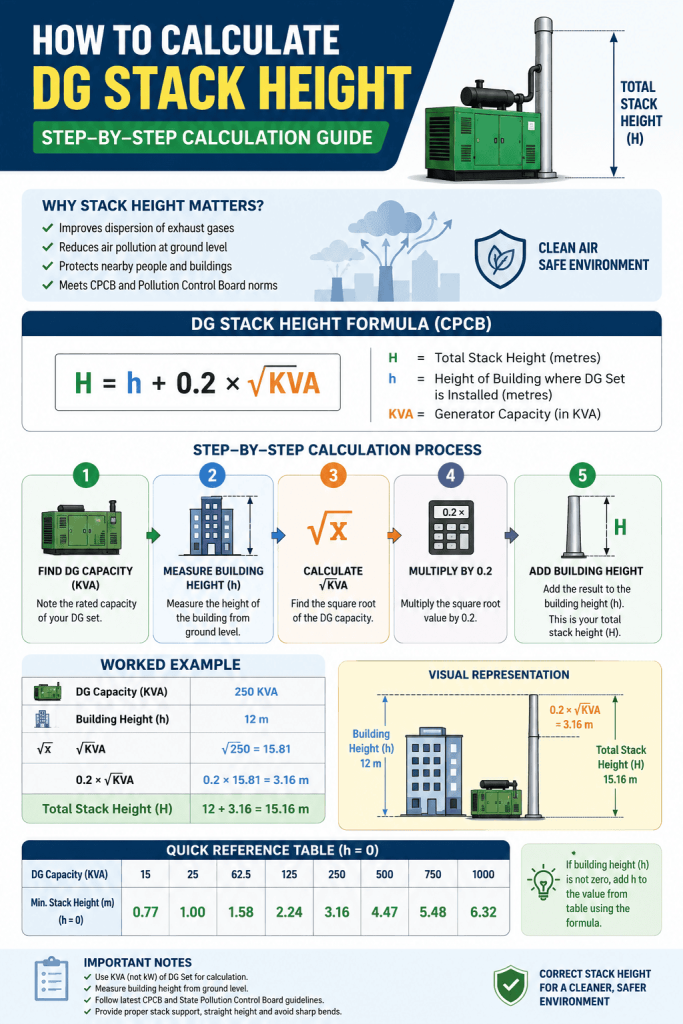
DG Stack Height Formula
DG Stack Height Formula (CPCB)
H = h + 0.2 × √KVA
Symbol
Meaning
H
Total Stack Height (metres)
h
Height of Building where DG Set is Installed (metres)
KVA
Generator Capacity
How to Calculate DG Stack Height Step by Step
Follow these five simple steps to calculate the required DG stack height using the CPCB formula.
1
Determine the DG Capacity
Identify the rated capacity of the diesel generator in kVA. This value is usually available on the DG nameplate or in the manufacturer's technical datasheet.
2
Measure the Building Height (h)
Measure the height of the building from the ground level to the roof where the DG set is installed. Record the value in metres.
3
Calculate √KVA
Find the square root of the generator capacity.
Example: √250 = 15.81
4
Multiply by 0.2
Multiply the calculated square root value by 0.2.
Example: 0.2 × 15.81 = 3.16 metres
5
Calculate the Total Stack Height
Add the building height (h) to the value obtained in Step 4.
Example Calculation
Building Height = 12 m
DG Capacity = 250 kVA
√250 = 15.81
0.2 × 15.81 = 3.16 m
Total DG Stack Height = 12 + 3.16 = 15.16 metres
Quick Tip: Always verify the calculated DG stack height with the latest CPCB guidelines, State Pollution Control Board requirements, and the DG manufacturer's recommendations before installation.
Step-by-step infographic explaining how to calculate DG stack height using the CPCB formula with a worked example, calculation process, and quick reference table for diesel generator installations.
Factors Affecting DG Stack Height
Although the formula provides the minimum required stack height, engineers also consider:
Measuring from roof level instead of ground level.
Using outdated environmental guidelines.
Not considering local pollution board requirements.
Installing bends that restrict exhaust flow.
Frequently Asked Questions (FAQs)
The stack height of a diesel generator (DG) set is the total vertical height of the exhaust chimney measured from the ground level to the outlet. A properly designed stack helps disperse exhaust gases safely into the atmosphere and supports compliance with CPCB environmental guidelines.
DG stack height is commonly calculated using the CPCB formula:
H = h + 0.2 × √KVA
Where:
• H = Total stack height (m)
• h = Building height (m)
• KVA = Generator capacity
A properly calculated stack height improves the dispersion of diesel exhaust gases, reduces pollution at ground level, protects nearby buildings and occupants, and helps meet environmental regulations.
No. The calculated stack height should be treated as the minimum requirement. Always verify the final installation against the latest CPCB guidelines, local Pollution Control Board regulations, and the generator manufacturer's recommendations.
Use the generator's rated capacity in kVA. Using kW instead of kVA may result in an incorrect stack height calculation.
Yes. Every diesel generator should have a properly designed exhaust stack or chimney that safely discharges exhaust gases and complies with applicable environmental standards.
Besides the calculation formula, engineers also consider building height, surrounding structures, wind conditions, generator capacity, local pollution norms, project specifications, and manufacturer recommendations.
Conclusion
Knowing how to calculate DG stack height is essential for every consultant, contractor, facility manager, builder, and DG owner. A correctly designed exhaust stack improves environmental safety, helps comply with CPCB guidelines, and ensures effective dispersion of diesel exhaust gases.
While the formula provides a straightforward calculation, always verify the final design against the latest CPCB guidelines, local pollution control board requirements, project specifications, and the generator manufacturer's recommendations before installation.